

The non-domicile (non-dom)/remittance-basis system, which originated in 1799 to safeguard colonial investments, was abolished in April 2025. This was originally instigated by Jeremy Hunt, then Chancellor of the Conservative Party.
What were the benefits of non-doms coming to the UK
Back in 2022, the UK Parliament explicitly described the ‘remittance basis’ as increasing the UK’s attractiveness as a place to “live, to work, and invest.”1
It was less about collecting tax on nom-doms’ offshore wealth and more about capturing the economic activity they generated inside Britain. Wealthy people tend to generate disproportionately large amounts of economic activity around them: lawyers, accountants, investment managers, domestic staff, restaurants, construction, luxury retail, property transactions, etc. There was an incentive to structure their finances carefully – but there was also a huge amount of UK consumption and investment happening.
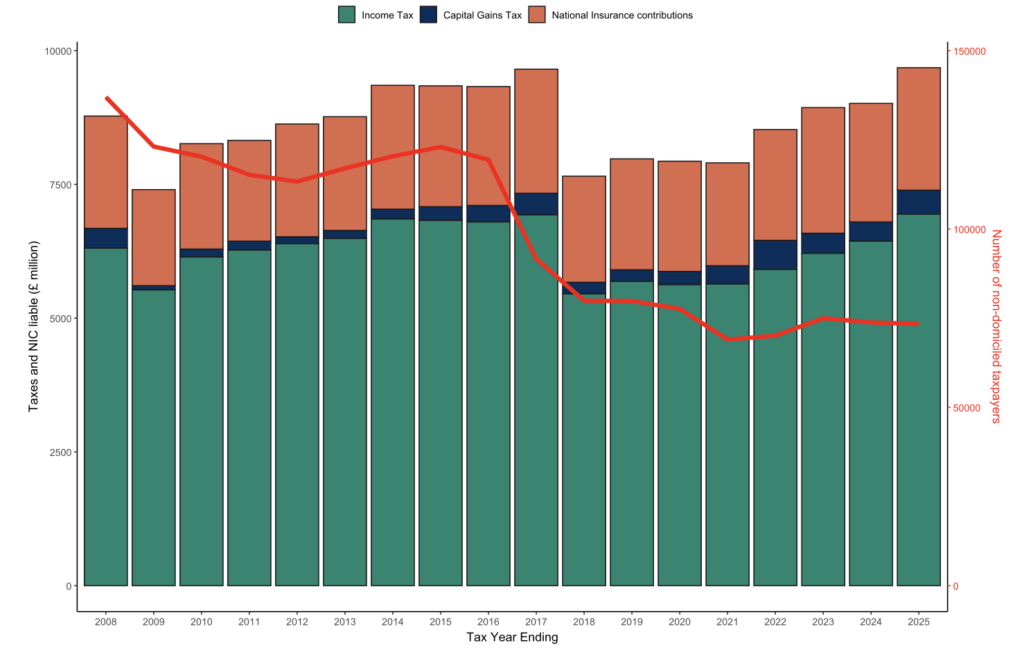
HMRC’s latest figures published on 30 July 20262, illustrate the scale. In the year ending 2025, around 81,900 UK-resident non-dom and deemed domiciled paid £13.6 billion in Income Tax, Capital Gains Tax and National Insurance. This was a 9% increase on tax year ending 2024, with close to three-quarters of liabilities for Income Tax.
However, the concern was this regime could encourage people to keep their wealth offshore to avoid UK tax, with The Treasury eventually concluding that the domicile concept incentivised people to keep income and gains offshore.
The new system
When announcing the replacement system, the Treasury specifically said it wanted to encourage people to bring overseas wealth into Britain, where it could be “spent and invested”.
New arrivals to the UK now benefit from 100 per cent UK tax relief on foreign income and gains for the first four years they’re tax resident, with a new transitional arrangement for current non-doms.3
Current estimates of nom-dom taxpayers
During the tax year ending 2025, the total UK Income Tax, CGT and NICs liabilities of non-dom taxpayers were £9.7 billion. The total amount of tax and NICs liabilities had increased by £668 million (7%) compared with the previous year. Although the population remains below its pre-pandemic level, the year-on-year change was small.4
Non-domiciled taxpayer numbers, Income Tax, CGT and NICs
gov.uk
In summary
From 6 April 2025, the UK abolished the old non dom/remittance-basis system and replaced it with The Foreign Income and Gains (FIG) regime, a residence-based system.
To qualify for 100% relief for the first four years, new arrivals must have been non-UK resident for 10 consecutive tax years immediately before the tax year in which they return. The four-years starts when they become a UK resident. As a UK resident, they then identify their qualifying FIGs and apply via Self Assessment for that year.
After the four years, if they remain a UK tax resident, they generally become taxable on their worldwide income like other UK residents. The FIG regime doesn’t make anyone exempt from UK tax; any UK income remains taxable in the normal way.
This preserves the original economic logic to some extent: “Come here, bring your talent and investment, and we’ll give you a tax holiday on foreign income for a few years.” But it removes the idea that someone can live in Britain indefinitely while permanently keeping their foreign income outside the UK tax net.
Sources
1 gov.uk Questions Parliament Published 17/10/2022
2 gov.uk Statistical commentary on non-domiciled tax payers in the UK Published 30/08/2026
3 & 4 gov.uk Spring Budget 2024: Non-UK domiciled individuals policy summary Published 6 March 2024
Contains public sector information licensed under the Open Government Licence v3.0.
SJP Approved 04/09/2026